Tags

Archives

Guest Post: Stop Building Features

Gimqz4xldoe_9ow483wsnkzhd9yexbsh6rhi6dere64,ntnvn3sbw09ik8l1gupqtvd7d3jossovxc5b3pzoq8i,jdjoh39doq4mydlgdp5eooqznkdzvnwiwoooesz73q8

[Editor’s Note: This post was written by 2014 graduate Connor Bowlan. Connor and his co-founder, Rhett, originally were accepted to The Brandery with their fashion and beauty advice app, Lookit. Throughout the course of the program, their startup evolved to what is now: Cintric, a joint venture between Connor’s company and another startup in the program. You can read more about their journey through The Brandery in this recent Soapbox article.]

Features are one of the worst things a startup can build into an early-stage product.

Features distract the company. Startups find success in innovative solutions to big problems. These solutions form the core of products, and are where the customer finds value they’re willing to pay for. At an early stage, startups should be focusing all their efforts on finding the best version of their solution by iterating on their core product. Feature development distracts from this task.


In one of the earliest versions of our application “Lookit,” we had a little robot character that guided the user through the signup process. The robot even had animations that would progress with each letter the user typed for their name and password. Was it neat? Definitely. Is animating the registration fields spending time improving the core product? Definitely not.

Features distract the product.

When creating a product that’s new, one of the biggest challenges is crystallizing exactly what it is. This applies in both the minds of the team and the end users. The simpler the product, the easier it is to understand what it’s purpose is and how to best achieve it. Features add complexity, and complexity distracts from the core purpose of a product.


In a later build of “Lookit,” we experimented with gamifying the platform. We built a series of “trinkets” that users could win by contributing to the community and gambling in a slot-machine feature. Session time skyrocketed to an average of 14 minutes, but we weren’t solving the problem we had set out to. It drew users away from the core of the product, and away from where we were able to give the most value.

Features distract the user.

When you’re building something new, the end user will have to learn how to use your product. Adding features means the user has more learning to do before being able to draw value from the product and use it effectively.

In the second build of our application “Quack,” we tried to solve one of our user-experience problems by adding another feature. This feature did away with one of the core rules of our product in order to get around a relatively small issue. In doing so we completely confused the user by introducing a competing ruleset, and made them go through another permissions process, all to implement a feature that ended up not being enjoyable for them to use.

Features are often wasted.

Startups frequently change their core products in significant ways as development progresses. When the product changes, features that have been developed often don’t have a place anymore and must be scrapped.
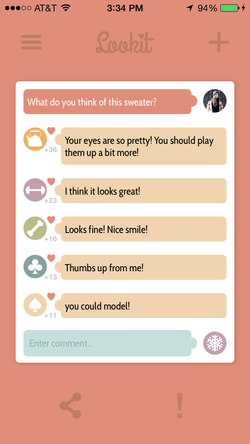


There is a fully complete card-based version of “Lookit” sitting on a bitbucket server somewhere that will probably never see the light of day. It has voting, a gorgeous UI, face-detection, and quite a few more features. Ultimately though, none of those matter. They’re great bits of design and coding that had to be thrown out because the core product they were built on wasn’t strong enough.

Once a product has matured enough to where it’s solving a user’s problem in the most efficient way possible, then features can be introduced to make that process enjoyable for the user to engage with. This must be done slowly though, so as not to confuse or overwhelm the user.

This is where the CPO role really shines, as their job is not just to guide what the product is, but also to guide what the product isn’t.

Building a product without features can be difficult. In the early phase of a startup, it can be challenging to avoid getting carried away in an environment where the product roadmap is set in something more akin to clay than concrete. This is where the CPO role really shines, as their job is not just to guide what the product is, but also to guide what the product isn’t. A good CPO will aggressively maintain development focus on the core of the product, even when features might be exciting or easy to complete.

-

At Cintric, we help developers build efficient mobile location services into their apps, from early stage startups that want to use location as a basis for their core experience, to large enterprises that wish to add location features to their existing and established apps. Cintric can be used to integrate rich location components that add a tremendous amount of value to the core of a product. Even including customizing experiences via demographic information and precise analytics of where users engage with different parts of the app.

If you’d like to chat about how Cintric can improve your mobile app with efficient and easy to setup location services, or you’d like to simply tell me why I’m wrong about features, contact me at [email protected].

Brand Camp: The First Two Weeks

Img_5025

We sat down with two of our startup co-founders in The Brandery Class of 2014, Connor Bowlan and Joel Green, to ask about their first two weeks at The Brandery. Connor Bowlan, 24 (CEO) studied sociology at the University of California, Merced. He previously served as the technical cofounder of a startup that built tools to automate bookings for residential cleaning services. Connor has spent time all over the world, most recently in Botswana where he attended the University of Botswana, studied micro-social interactions, and explored Southern Africa by motorcycle. Joel Green, 21 (CEO), is a mobile and python developer who recently dropped out of the University of California Santa Barbara. Over the last several years, Joel has spent time developing robotics, conducting undergraduate research at UCSB, building automated lab tools, and participating in hackathons as an iOS developer. Previous to engineering, Joel has spent time as a Jazz pianist and music composer.


Connor (left) and Joel (right) sporting red shirts under the Cincinnati sign.

What is the most surprising thing about Cincinnati so far?

Joel: I’ve definitely been surprised at how friendly people are. Especially compared to California, everyone is so willing to help with things all the time. I’m more than pleasantly surprised by Cincinnati. I’m pretty stoked on this place. My plan is to stay here as long as it is in the best interest of my startup, and I see no downside of that at all. I’m really happy here.

Connor: It’s such a close knit community. There’s no fatigue related to startups like in the Bay Area. If you tell someone you’re going to startup in the Bay Area you usually get an eye roll and they change the conversation. Here, they ask you what you are doing and ask you how they can help. The main thing is that people are welcoming and open to it. It’s not seen as a threat.

Joel: Another thing that surprised me is how much design and marketing talent there is here. I’d never really known that much about Cincinnati, besides a few things I’d read here or there. Once I did my research, I said, “Oh, okay. There is P&G, and there is Kroger, and there are some headquarters here.” But once I got here, I was like, “Wow, UC is here and marketers are literally everywhere.” It’s amazing. If San Francisco is known as the city of tech, Cincinnati is the city of marketing. It’s pretty big.


Best part about the city?

Joel: So far, the cost of living is definitely my favorite part, plus there’s so much to do here. Honestly, for half the price of a really crappy place in California, I’m living in the nicest place here. This is the kind of place I imagined I’d be living in if I sold my company, not when it’s just starting out, and it’s so easily within budget. Also, the architecture is super ancient and cool but everyone here is so high-tech and into the latest things and carrying around the newest device.

Connor: There’s so much excitement and enthusiasm for the OTR area. It extends past startups, to small businesses in general. Everyone wants to introduce you to their connections. They don’t see their connections as resources, but more of interpersonal relationships. It takes one day to get a reference to anyone in the city.


What has been the best day of The Brandery so far?

Joel: Brand in a Day was definitely very interesting. It was early, and a lot of stuff was going on, so it was challenging, but it was so productive. My favorite day was when we started Failbone/Quack with Connor and [Connor’s co-founder] Rhett because thats when we got to know each other the best. Failbone originally spawned from Connor playing a trombone noise whenever someone failed at something. Then, we built an app that played it in a radius on everyones phone. From there, Connor decided to come up with his own thing, Quack, which evolved into what we all use now at The Brandery.

Wait… so what’s Quack?

Connor: Quack is a location-based messaging platform that removes all barriers to interaction. It allows people to communicate quickly and efficiently, much like you would in real life. Theres also an element of humor in it, which really brings people into the platform and allows them to express themselves without the fear of guilt or judgement. The thing that excites me most about Quack is that if you’re not staring at it all the time, you feel like youre left out of the joke. It makes you feel like you were last picked for the baseball team in elementary school, so it forces you to look at the app all the time. It’s like having an inside joke that everyone within 400 feet is in on.

Joel: At this point, there’s an iOS, Andrioid, and Pebble version of Quack which have come together from members of three different startups. It’s like a monstrosity of a startup that has spawned out of all the companies. The funniest part is it’s the most popular one.


A screenshot of Quack for iOS.


What is the most unique part of The Brandery?

Connor: The excitement and palpable feeling that everyone is on the edge of something big is really exciting. Everyone is silently (and sometimes not silently) pushing each other forward. My favorite thing is being around other people every day while I work. For the past eight months or so, it’s just been me in a room working, but that is not exciting as being around people everyday who are so much more inspiring.

Joel: I’m surprised at how many resources The Brandery actually provides. The $20k seems almost insignificant compared to how many resources we actually get. Any resource you could possibly need is pretty much available on the first floor— at any hour— just by asking the other startups in the room.

Connor: I didn’t realize how much I would actually think of The Brandery as home. After we’d been here for two weeks, we felt like we’d been here for two months. We were able to get integrated so quickly. You have an ex-Army Ranger sitting next to a 19 year-old college dropout, who is sitting next to the drummer from a platinum selling rock band, who is sitting next to a finalist from Survivor. Where else will you find that?


What has been the most beneficial part in building your business?

Connor: The mentors have been great in getting us to think about things we hadn’t even considered before. The mentors have leveraged a lot of resources for us and helped connect us to a lot of people. They give us a lot of quick insights that they have from years and years of experience that help us focus and not flail around and not know what we doing. It’s also surprising how much the big corporations in Cincinnati are willing to help. Usually, in the stereotypical startup narrative, they are the villains. But really, they are so open and willing to help with mentoring, which is impressive.

Joel: There are 12 startups from all diverse backgrounds here, so whether its development, connections, marketing, life, or business, there are always people there to help you. That’s the most powerful thing. Having everyone here 24/7 is the best thing so far.

Keep checking back for more updates on The Brandery Class of 2014, including info on their startups and their continued transition in Cincinnati. #Brandery2014

Brandery Storytime: FlightCar

Home-slide-flightcar

Quick Facts


Company: FlightCar
Brandery Class: 2012
Launched: 2013
Total Raised: Over $6M
Locations: 3, SFO, BOS, and LAX
Cars Rented Out: Over 5,000


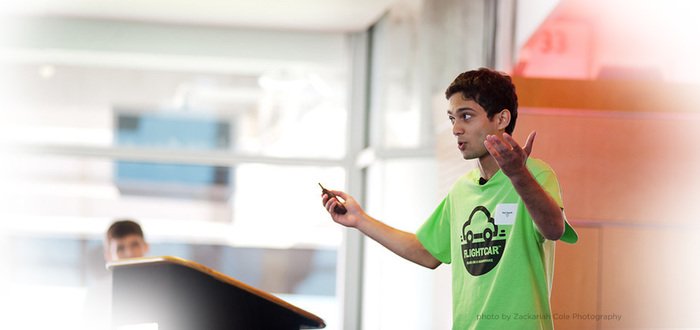
It’s just another day in 2012. Rujul Zaparde and Kevin Petrovic are sitting at Panera Bread, enjoying their last few months of high school. It’s March, and Rujul and Kevin already have their acceptance letters to Harvard and Princeton, respectively. Rujul mentions to the well-traveled Kevin that he’d recently read an article about a startup called Airbnb. They start discussing, and an idea emerges.

“If people are willing to share their most valuable asset, their house, why wouldn’t they be willling to share their second most valuable asset, their car?” Rujul asks Kevin. People could drop off their cars at the airport with them instead of parking in long-term parking at the airport, and visitors that needed to rent cars could just use the bank of cars they already had. It would save everyone involved money.

The story would be great if they instantly started drawing up plans for their startup, building their business, and raising capital. But that’s not how it goes.

“We thought it was a terrible idea and ignored it for about a month.”

Kevin and Rujul had known each other for about ten years through school, and had already started a non-profit together, called Drinking Water for India, that brings safe drinking water to rural areas of India.
A month or so later, the idea came up again. It didn’t seem so terrible anymore. Rujul and Kevin decided to investigate its potential. At this point, they didn’t know what an accelerator was, let alone think they would be at one in two months.
They began doing some research and, as Rujul puts it, “began asking dumb questions.” Some of this research led them to learn that accelerators exist, and The Brandery seemed like a good option for them. The application deadline was the next day.

They applied, and after picking up their developer, Shri, from MIT, the guys flew to Cincinnati for their interview. “We saw their application and that they were three guys from Harvard, Princeton, MIT, and thought, ‘okay, well that is interesting,’” explained GM Mike Bott. “So we invited them to come interview as a finalist. We offered Google Hangout as an option, but they said they would rather come in person. They asked if they could come interview on a Friday for some reason, and on the way back from the airport— obviously at this point we had realized they were a lot younger than their application had alluded— we asked them why they needed to interview on a Friday. Rujul said, ‘Well, Kevin’s high school graduation is tomorrow. We thought you would take us more seriously if we showed up in person.’ They knew they really had to sell themselves.”

Ultimately, FlightCar was accepted to The Brandery’s 2012 class, making them the youngest co-founders in any class, at 17. In June, they ditched their plans for an Ivy League education, poached their developer from MIT, and moved to Cincinnati to tap their idea.

“We were just excited to meet mentors and be around people that thought we deserved $20k.”


Rujul, Kevin, and Shri showed up to The Brandery with the idea, the name, FlightCar, and a logo that “looked like a car with a shark fin on top of it— it was bad.” Right away, they got to work trying to find parking lots to use for the launch of their car sharing service. It was hard. To add to that, they were beginning to tackle the critical issue of acquiring insurance for the vehicles they would be renting out. About five weeks into the program at The Brandery, they were told that it couldn’t be done. Insurance would be impossible. Should they just shut down? Why would anyone lend their car to a stranger without insurance?

Meanwhile, FlightCar’s agency partner, Landor, was hard at work on their brand.

“They could not have done a better job. Landor was excellent in helping us figure out how to present ourselves. It wasn’t just a logo and a color scheme, which they did give us, but it’s a lot more than that. The concrete stuff was great, but what they really helped us out with was actually creating a brand. We didn’t understand A) what a brand was or B) what our brand was. The tagline, the tone of voice we use, that is all attributed directly to Landor.”

By the end of the program, Rujul, Kevin, and Shri had built a working prototype, established viable markets, acquired early investors, and done the impossible right before Demo Day, had insurance committed. They were prepped to launch.

What happened next?


After FlightCar graduated from The Brandery, they faced more challenges. Investors wanted to see traction, and they didn’t have it yet. They had all the tools to launch, but didn’t have the capital to secure parking lots. This was FlightCar’s “trough of sorrow.” They went from October to December trying to fundraise with no traction. They had the connections from The Brandery, but nothing was lining up. After four tedious months, they raised their first round and were able to launch in their first city, San Francisco.

A few months later, FlightCar applied (again on the last day that applications were open) to Y Combinator and was accepted. They were still scaling, still finding the numbers, and YC helped them through that process while they kept fundraising. FlightCar began to take off— they received tons of press and raised their series A in 14 days. And then they got sued.

The City of San Francisco filed a lawsuit against FlightCar that suggested they be subject to the same fees that the rental car companies have to pay the airport for being on airport property. FlightCar is not located on airport property, but the city argues that they should pay since they are using their customers. They handled the lawsuit with class and kept pressing on.

Today, FlightCar is in San Francisco, Boston, and Los Angeles, with other cities coming very soon.

How did The Brandery help FlightCar?

“If we hadn’t gone to The Brandery, I don’t think we could have gone through with any of this. I 100% wouldn’t have changed our decision to go through the program. You’re in one location with [GM Mike Bott] and all the other companies who get to know you so well. You can walk 25 feet and get any question you have answered and walk back to your desk and think about their answer. We just had so many questions and it is the absolute best way to get all of those questions answered. That was the number one thing for us. That, and everyone was there all the time, which is unlike other accelerators. Most people even work on Saturdays, which helps you stay on track with the other companies. You saw everyone every day. The Brandery holds your hand a lot more that other accelerators, which is a good thing. We needed that.”


Rujul’s advice to future Brandery companies?

“Use the program as much as you can. Work seven days a week. Take things in stride and focus on what you need to get done.”

Apply to The Brandery now.

Accelerator Update: Week 5

Clientname_130717_d7z_7800-2655854690-o

Can you believe it’s already week five of our accelerator program? Yeah, neither can we.

The momentum is picking up. The companies are coming in earlier and staying later as many of them launch their alpha and beta products. Final company branding is being nailed down. Websites are being fleshed out.

Each week of the program is focused on a different area of building a startup to help keep everyone working quickly and thoroughly. So far, we’ve completed “Branding for Startups,” “Design and Consumer Understanding,” “Founders’ Advice,” and “Defining and Building Your Product.” This week is focused on “Building Your Business Model.” We bring in experts in each of the fields to share their thoughts, lead workshops, and sit down and talk with each of the companies to try to address their specific needs. As General Manager Mike Bott says, “Each company is a slice of Swiss cheese. We want to help them fill in the holes.”

Last week, we had professional photographer Zackariah Cole join us to take some shots of the space, each company, and the Brandery co-founders. He did a phenomenal job. We’re pretty obsessed with his photos. It’s always been hard to capture what our space looks like, but Zack nailed it.


There’s been such terrific progress with all ten companies in such little time. It’s hard to grasp how hard the teams have been working. We want to share the excitement with you. Here are a couple companies that are killing it right now (we’ll update you on a few more next week):

Accrew is an all-in-one accountant collaboration tool. It enhances your current software to allow clients and their accountants to communicate seamlessly and give feedback through an interactive dashboard. Their team is made up of Craig, Ryan W., and Ryan B. from Columbus, three accountants that started a firm called Upsourced Accounting together. We’re lovin’ on Accrew’s Modern Accountant Blog these days, and they are holding two events at the Brandery in the near future. Come learn more about the co-founders, their business, and the changing accounting landscape. You can find more information and Eventbrite sign up for Accrew’s events in their blog.


Craig and Ryan B., two of the three co-founders of Accrew


Chalky is a duo of Stanford sophomores that wants to help high school students get into college and help college students succeed in their education and beyond. Operating in stealth mode until now, Chalky has created a peer-to-peer mentoring system for students. They’ve been crazy busy building out their site and system in the last few weeks and we love what they’ve accomplished so far. You can sign up for Chalky’s private beta here.


Charlie and Isaac, co-founders of Chalky


Looking for updates on our graduates? Don’t worry, they’re coming soon! Lots of exciting things have been happening for our grads. Did we mention that Brandery alum FlightCar is coming to the Brandery for the August edition of Startup Grind? Don’t miss it!

All images in this post courtesy of Zackariah Cole Photography.

Meet the Mentors: Joe Medved, SoftBank Capital

1. Tell us about yourself! Who are you and how are you involved with the Brandery?

I am a Partner at SoftBank Capital, a venture capital fund focused on mobile applications, social media, ecommerce, online advertising, gaming, and cloud computing. I have been a mentor at the Brandery since its inception. Dave Knox, who had been a great mentor to companies in our portfolio, encouraged me to join the program when it launched.

2. Why are you passionate about the startup community in Cincinnati?

I grew up in New Hampshire but my parents both came from Cleveland, so I have personal ties to Ohio and great fondness for Cincinnati (except when the Bengals are playing the Browns). Dave, JB, Rob and Bryan laid out a vision that would leverage Cincinnati’s industry leading consumer companies and wealth of design talent. The timing was perfect given the evolution of the web, as open source solutions and utility computing leveled the playing field a bit on the infrastructure side, enabling a new wave of innovation at the application layer. Great branding and design, which the Brandery and Cincinnati represent, are the key elements to differentiation at this layer of the stack.

3. As a specialist in investments and venture capital, what is your biggest piece of advice for applicants and aspiring entrepreneurs?

One of the most important things an entrepreneur does in his or her company’s infancy, is to hire the right people to build their team. The same diligence that is put into the recruiting and hiring process should be applied when selecting mentors and investors. Having the guidance of Mike and the team at the Brandery can help entrepreneurs identify the mentors and investment partners that are optimal for their business goals and culture.

4. If you started a company, what would it be?

Many of the greatest startups, particularly on the enterprise side, are built by people that are attempting to solve a problem they’ve experienced firsthand. Being a VC is an incredible job, but one pain point in the job is email. We network with an extraordinary number of people in order to help our portfolio companies and identify new entrepreneurs to back. I am constantly behind on email and feel bad about responding slowly. My dream company would be one that completely disrupts email with a more efficient form of communication.

5. What are your goals for the Brandery as a mentor?

My goal is to share my perspective in areas where I have significant experience and to help make connections with experts in areas where I don’t. One of the things that I learned early on as a VC, from my partners who had decades of experience operating and investing, was to understand your strengths and weaknesses as a mentor. Just because you help control a lot of investment dollars, people may assume you’re an expert on every facet of being a startup, or worse off, you may believe it yourself! Our team has investors from a variety of backgrounds, ranging from sales to product to tech to finance. We aim to leverage those talents across our portfolio, and I try to take the same approach to my mentorship role at the Brandery.

My goal as a mentor representing SoftBank Capital is also for us to find great companies to invest in, which we did recently with FlightCar. I mentored the team at the Brandery, and we are thrilled to be investors in the company. The Brandery helped the brilliant young team at FlightCar craft a powerful brand message that is clearly resonating in the market.

For more information about Joe Medved or any of our mentors, visit www.brandery.org/mentors!

Meet the Founders: Rob McDonald

The Brandery has decided to feature more of our companies, mentors and founders! Please take this opportunity to learn more about one of our co-founders, Rob McDonald!

1. Tell us about yourself! Who are you and how are you involved with the Brandery?

I’m Rob. I’m a Co-Founder of The Brandery. I’m also an attorney at a local law firm called Taft Stettinius and Hollister, LLP. Prior to attending law school, I worked in advertising for TBWA\Chiat\Day, so I have an odd mix of marketing, venture capital, and law experience. As my co-founders sometimes joke, I’m the co-founder that makes sure that no one gets in trouble and that we are doing everything by the book. In all seriousness though, all of the co-founders are pretty good about trading off responsibilities between each other based on capacity. So, my role is ever changing but includes working with the companies on a daily basis, assisting our Brandery team to manage our day-to-day operational needs, and thinking strategically about what The Brandery should be doing.

2. Why are you passionate about the startup community here in Cincinnati?

When I moved to Cincinnati in 2009 it was clear that we had a problem; smart young professionals were fleeing. I thought that if The Brandery could be successful in fostering a high-tech start-up community in Cincinnati, there would be a palpable energy that would not only stop young people from fleeing Cincinnati, but also draw top talent to Cincinnati. Dave and JB convinced me when we all first met that we had the ability to reverse the course locally. I’ve said it before but 3 years removed from when we launched The Brandery and I feel like we are the precipice of something pretty special. I think this must be how the Napa vineyards felt in the 1970’s. They thought they could take on the French and create world class wines. I feel like we can take on the coasts. We have some start-ups that are proving this.

3. What is your biggest piece of advice for applicants and aspiring entrepreneurs?

Tough question. I regret that I likely have too much advice for applicants and aspiring entrepreneurs. The one major learning for me over the last three years has been to focus on people, not ideas. In our first year, we really focused more heavily on ideas (i.e. What idea does the applicant have?). In year 2, we focused more on team (i.e. Who is on the team?). In year 3, we started to get even smarter and focused on the team and the idea (i.e. Does the team have the capacity to execute the idea?). Now, I think we have gotten relatively good at selecting teams that have the capability and grit to create a business. The term grit has been used quite a bit in education recently, but it is absolutely necessary for entrepreneurs as well. Suffice to say, my one piece of advice would be to build out an incredible team that has the skills to execute the idea.

4. If you started a company, what would it be (does not need to be a serious answer)?

I would start a business accelerator and call it The Brandery. Just kidding. Everyday I think of 100 new businesses I want to start. Last night, I really wanted to start a company to create machines to fold my laundry for me. Kidding again, but seriously, how useful would that be!

5. What are your goals for the Brandery?

Our long term goal has always been to make the Brandery a self-sustaining community. We need the Brandery to remain a powderkeg of innovation and we need it to be built to last for several decades. I think the concept of having successful Brandery graduates fueling future Brandery graduates decade over decade is a powerful vision. So far, so good.

Have additional questions for Rob? Email us at [email protected]!

Get REVVED!

Wanting to get involved in development and/or the Cincinnati startup scene? Looking for a quick way to develop new skills?

Well, you’re in luck.

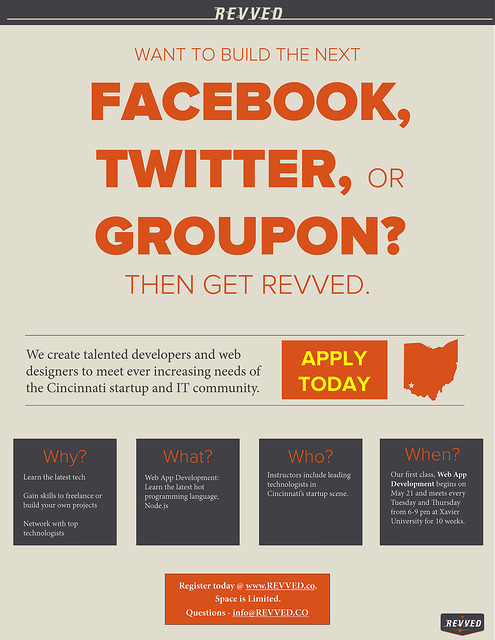
The tech minds behind Brandery graduates Modulus and REPP are starting Revved - a series of classes that will teach new and seasoned developers the skills they need to move to the next level. With the support of Xavier University, Cintrifuse and The Brandery, Revved will help create top notch development talent here in Cincinnati.

Interested? The first course, Web Application Development, is scheduled for May 21 at Xavier University. Space is limited, so make sure to register ASAP: http://www.revved.co

REPP Offering Free Profiles for Brandery Community!

REPP Offering Free Profiles for Brandery Community!

Have you ever wondered if your online date really was being truthful or if that person coming over to your house from Craigslist is a convicted felon? Well a Brandery graduate can help ease your worries, and for a limited time, it’s completely free!

REPP was founded in June 2012 and is located in Cincinnati, Ohio. It is the first and only company to allow users to create verified online profiles that are easily embedded and shareable, using a patent pending process.

Using your full name, date of birth and address, REPP develops personalized quizzes only you would know, searches national records to retrieve your criminal record, allows you to confirm and add your social media sites to your profile, and soon, will verify your profile photo. Once your profile is set, share it with others and ask to see their REPP.

REPP recently launched a beta version of their platform and is offering free
profiles to the Brandery community!

For more information, please visit www.myrepp.com or email [email protected]

Company Update: Pingage

COMPANY UPDATE: PINGAGE

As much as we enjoy interacting with our companies during the summer sessions, we especially love watching them succeed post-launch. One of our 2012 graduates, Pingage, has experienced tremendous success since Demo Day and is this week’s featured company!

Here is a blog post written by Pingage President and Co-Founder, Bob Gilbreath:

Celebrating our Launch with Stories and Client Success

We recently announced the official marketing launch of Pingage, our new Pinterest marketing optimization platform. After months of quietly toiling away, we are finally proclaiming to the world that we exist. For some companies this would be a cause for a major celebration and spawn a lavish party. Not at our office. We cracked a few Wohlschlaeger home-brewed Belgians, of course, but what we really celebrate is driving amazing results for our clients. Now we get to start celebrating those results more publicly—and attract companies that are ready for a completely new model of social media marketing.

Michael went back to the basics of how people use Pinterest. He started with great content, adapted it specifically for Pinterest, developed algorithms to time when pins are placed, tweaked landing pages to drive conversion, and created new analytics software that he used to gauge results from daily experiments and make improvements for the next day of pinning.

I joined Michael as co-founder, and we prepared to approach large brand marketers with our new product. We wanted to disrupt the current marketplace and unlock the vast potential of social media marketing by bringing two new benefits: First, we chose to develop a system that reduced the work of brand marketers. Second, we decided to only charge for results—just like a media buy. This combination leads to a powerful win-win loop: The more work we do for clients, the better the results, and the better the results, the more we grow together. Pingage is great service, powered by software, and paid as media. No one in the marketing space offers this combination.

In the past six months we have been quietly working with a handful of companies—ranging from e-commerce startups to billion-dollar CPG brands. Several brands and agencies have reached out to learn more. They are waking up to the possibilities of Pinterest, yet searching for a new model.

We find it incredibly exciting to sell something that solves this challenge, and scale up the technology that Michael developed in his basement to bring great content to millions of consumers’ lives each day. It’s also a blast to be able to add awesome members to our team and brilliant investors to our roster as we prove success.

On we go!

Bob Gilbreath, Pingage

We are extremely proud of the company’s success and look forward to its continued growth.

For more information on Pingage, please visit their website.

Have an idea that will change the media industry?

The Brandery, in conjunction with the Scripps Howard Foundation and the EW Scripps Digital division, are looking for a startup passionate about disrupting the news media industry.

Learn more about the partnership here.

Come share your business idea at the final Brandery Office Hours tomorrow from 4-6. RSVP here.

Apply now! The final Brandery deadline is May 1st.

We're Hiring!

Several of our Brandery graduates have experienced tremendous success and are hoping to expand their teams! See below for a list of available positions:

ROADTRIPPERS

Designer

Roadtrippers is seeking a motivated and creative graphic/interactive design intern with strong skills in layout and typography, and UI.

You will be:
• Producing layout for promotional materials.
• Sharing your eye — and talent for — typography, layout, and color.
• Creating design standards and style guides
• Improving uniformity across our products and the web.

You must have:
• A strong portfolio (if it’s not online or if it’s ‘coming soon’ it doesn’t exist)
• Adobe superpowers
• The ability to work fast (process only matters at school, here it’s about product)
• A laid back vibe, and a sense of humor (but still know what hard work looks like)

Extra points for:
• Front-end dev experience: HTML, CSS, jQuery

Interested? Email Chelsea Koglmeier ([email protected]) with your resume and a link to your portfolio.

Software Engineer / Web Developer

Roadtrippers is looking for a talented and passionate Software Engineer to help us build solutions to fragmentation problems in road travel planning. You will be developing key features of our web application.

You must have:
• Software development experience. And be very, very good at it.
• Have experience with Rails, JavaScript, Python, Java, PHP, Node or other scripting languages.
• Versatile in development skills across client, server and database admin
• A good sense of humor
• Not have a ‘stick up your arse’

We use:
Ruby on Rails; Backbone.js; jQuery; CoffeeScript/JavaScript; MongoDB; PostgreSQL; CSS (SASS/SCSS); Google Maps; Cloud Computing (Engine Yard, S3 etc); Mac OS X and Linux; Cucumber, RSpec and Jasmine testing frameworks; Agile, scrum methodology

Bonus points for knowing:
Test driven development, MapReduce and in depth MongoDB/NoSQL, Geo / mapping development and APIs, Ruby on Rails hosting setup and management, iOS / Mobile, Single page web app development, Being a challenging foosball player

Interested? Email Chelsea Koglmeier ([email protected]) with your resume and why you’d be a good fit with this position.

REPP

Junior Web Developer

OVERVIEW
REPP (www.myREPP.com) is an online identity verification company located in Cincinnati, Ohio. REPP is a 2012 Brandery graduate and was named one of CNBC’s World’s Most Promising Companies and has been featured in The Huffington Post and Cincinnati Enquirer.

OPPORTUNITY
REPP is looking for a Junior Web Developer to help in the development and testing of our Identity Management and Background Check service platform.

Primary responsibilities would include:
• Troubleshooting bugs
• End user support
• Application testing
HTML & CSS development
• JavaScript development on both the client and server side (Node.js)

Required Skills:
• At least 1-2 years experience using HTML & CSS
• At least 1-2 years experience using JavaScript
• Ability to work on a team
• Excellent interpersonal skills for end user support
• The desire and flexibility needed to work at a small startup
• Dependable, Organized, and Resourceful
• Eager to learn, quick to do, and self-directed

CONTACT [email protected] for more information!

Company Update: SocialThreader

Check out what SocialThreader has been up to since Demo Day in October 2012:

As much as we enjoy interacting with our companies during the summer sessions, we especially love watching them succeed post-launch. One of our 2012 graduates, SocialThreader, has experienced tremendous success since Demo Day and is this week’s featured company!

The company’s CEO, Vinay Murthy, describes SocialThreader as a tool that “increases the effectiveness of digital marketing by leveraging social media in ads and websites. It allows seamless integration of a brand’s social content from Twitter, Facebook, YouTube, blogs and websites as well as consumer and influencer voices from social platforms.”

Quite simply, SocialThreader is a platform that threads all of a brand’s social (earned), web-based (owned) and digital media (paid) together into one seamless experience. It can be embedded on websites and linked to other sites. The tool was initially piloted with Bush Beans and will soon be used by a variety of different brands.

SocialThreader not only threads content, it also allows brands to curate and target specific consumers and measure time on sites, page views and uniques. This enables brands to maximize the acceleration of social engagement for their entire portfolio. The tool is fully customizable and the team continues to add new features.

SocialThreader was recently awarded a “Digital Innovation Project” from Procter & Gamble. Vinay and his team will work with the ethnic marketing group at P&G to roll out social integration of their owned and earned content on their .com site. The company was also selected by Kroger, a major national grocery chain, to promote their organic brand of products and has entered into a partnership with a market leader in commenting platforms for distribution of social content for brands.

We are extremely proud of the company’s success and look forward to its continued growth.

For more information on SocialThreader, please visit their website or email [email protected]!